|
 We invite you to join our gay Tanzania safari & explore of one of the most well-preserved wilderness areas on earth. Tanzania has more land devoted to wildlife than anywhere else in the world. See what draws celebrities from around the world to spend days or even weeks in Tanzania. Walk on the wild side in Tanzania! This gay safari hits all the best spots, starting from Arusha with distant views of Mt Kilimanjaro, to Tarangire National Park to see herds of elephants. We then climb up the East African Rift to a wild wonderland of exotic animals who have created an ecosystem in the basin of a great volcanic crater. We invite you to join our gay Tanzania safari & explore of one of the most well-preserved wilderness areas on earth. Tanzania has more land devoted to wildlife than anywhere else in the world. See what draws celebrities from around the world to spend days or even weeks in Tanzania. Walk on the wild side in Tanzania! This gay safari hits all the best spots, starting from Arusha with distant views of Mt Kilimanjaro, to Tarangire National Park to see herds of elephants. We then climb up the East African Rift to a wild wonderland of exotic animals who have created an ecosystem in the basin of a great volcanic crater.
Many cultures have left their imprint and we visit a few, including ancient hominids found at Olduvai Gorge and the current Maasai warriors closely guarding their prized cattle from natural predators. The last half of our safari is spent on the expansive savannas of the Serengeti, said to be the greatest assemblage of wild mammals in Africa. Tanzania is a slice of true Africa where the animal rules supreme. Where land is free of the encroachment of modern civilization. Tanzania has more land devoted to wildlife than anywhere else in the world. For the Safari aficionado, Tanzania is the ultimate and is a true paradise.
Join us to see one of nature’s best shows. A safari through the greatest congregation of large mammals anywhere in the world.
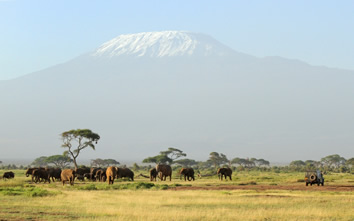
Following Hemingway’s expeditions, we will journey across the wilds of East African, from Mt. Kilimanjaro almost to Lake Victoria. Great herds of elephants fill our first days before we climb up the Ngorongoro Highlands for visits with a local tribe and a remarkable, organic coffee & produce plantation. Dropping 1800 feet to the floor of the extinct Ngorongoro crater, we will find thousands of animals grazing, breeding and interacting—not always peacefully—in this unique paradise.
We will also visit with Maasai warriors. As well as one of the most important paleoanthropological sites in the world, Olduvai Gorge, from Louis and Mary Leakey’s fame. Our journey takes us to the wonders on the expansive savanna of Serengeti National Park, dotted with granite kopjes and dominated by large predators.
During our safari, we are likely to see leopards, dozens of lions, cheetahs, hyenas and herds of cape buffalo. Gazelles, ostrich, giraffe, baboons, elephants, hippos, crocodiles, wildebeest, and zebra are in abundance, not to mention the adorable warthogs. Each night we will rest safely in unique and beautifully sited, upscale lodges and luxury tent camps. We promise you a remarkable experience and truly the trip of a lifetime!

• Experience wild Africa – Tanzania has more land devoted to wildlife than anywhere else in the world.
• Sleep each night at upscale, remote lodges and luxury tented camps (with en suite, of course!)
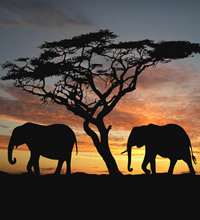
• Visit Tarangire National Park, home to herds of elephants and filled with wonderous Baobab trees
• Descend 1,800 feet to the floor of Ngorongoro crater, one of the world’s largest, and without doubt the one most jam-packed with almost all the various mammal types in East Africa, including the rare black rhino.
• Walk in the path of ancient hominids at Olduvai Gorge where the Leakey’s made many of their great archaeological discoveries.
• Gaze for days across the vast Serengeti savanna, seeing wildebeests, zebras and elephants graze and then gather around watering holes, all the while keeping a watch out for lions and other predators.
• View pools of water filled with huge hippopotamus. And nearby giant crocodiles sunning on the sand.
• Fly back to our starting place by light aircraft for a bird’s eye view of this unique wonderland.
• Join our optional extension to the romantic and mysterious Indian Ocean island of Zanzibar.

Day 0 -
Most North American travelers will depart home a day before the first day of the tour. See our FAQ about flights to see the variety of options available to Kilimanjaro and home from Kilimanjaro or Zanzibar or Dar es Salaam for those on the extension.
Day 1 -
 Upon arrival at Kilimanjaro Airport, you will be met by our representative and transferred to our hotel near Arusha, about 30 miles from Kilimanjaro Airport. You can enjoy the balance of the day at leisure. Upon arrival at Kilimanjaro Airport, you will be met by our representative and transferred to our hotel near Arusha, about 30 miles from Kilimanjaro Airport. You can enjoy the balance of the day at leisure.
Our first hotel and resort have all the modern conveniences you expect. It is the perfect place to relax before embarking on your safari experience. The lodge boasts magnificent views of the mighty Mount Meru and, just beyond it, possibly the snow-capped Mount Kilimanjaro. Meet your other tour members for an early evening reception. Dinner is on your own tonight since some of the most convenient flights arrive later in the evening. Prepare to depart for your safari tomorrow.
Days 2 - 3 -
 Today we will depart Arusha and drive to Tarangire National Park. This park is a hidden gem off the main tourist route and home to imposing giants: elephants and baobab trees. Today we will depart Arusha and drive to Tarangire National Park. This park is a hidden gem off the main tourist route and home to imposing giants: elephants and baobab trees. The largest population of elephants in Northern Tanzania call this home, often sighted in large herds. And the baobab tree, or “tree of life,” that fills the plains. With many myths and legends, it provides food, water, shelter and medicine in this arid African environment. Folklore mentions that the tree seems to have ben planted upside-down.
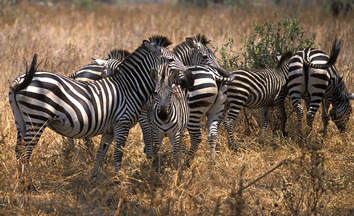
 Enjoy huge herds of zebra, eland, and oryx gather to stay in Tarangire until the onset of the rains when they migrate again to good grazing areas. Those beasts are often tracked by lions, leopards, and other predators. Enjoy huge herds of zebra, eland, and oryx gather to stay in Tarangire until the onset of the rains when they migrate again to good grazing areas. Those beasts are often tracked by lions, leopards, and other predators.
We will have two nights in the park, with game drives on arrival and the next day. A permanent luxury tent camp will greet us each evening (instead of a basic tent, think more of a tent-like cabana, with private veranda, full beds, and ensuites with hot and cold running water). Here, we will enjoy great meals and a broad view across the landscape.
Day 4 & 5 -
 Today we make our way further west, visiting a traditional tribe, where the local guides share with us tales of their culture here on the rift. Then, after a lunch of traditional Tanzanian dishes, venture to the Ngorongoro highlands, past coffee plantations and to our accommodation for the next two nights. Today we make our way further west, visiting a traditional tribe, where the local guides share with us tales of their culture here on the rift. Then, after a lunch of traditional Tanzanian dishes, venture to the Ngorongoro highlands, past coffee plantations and to our accommodation for the next two nights.
Situated on top of a valley, overlooking the Eastern wall of the Ngorongoro Crater and a beautiful waterfall, is your exclusive lodge. The lodge consists of spacious suites built inside of cottages reminiscent of an old colonial farm, all with en-suite facilities and stylish contemporary décor. Meals are served in the main building. Relax and unwind in the tranquility of the beautiful gardens, at the heated pool or in the African spa.
 In the early morning, board your Land Rover for an amazing journey as you descend over the edge and down to the floor of this extinct volcano, It is claimed to be the largest unbroken caldera in the world that isn’t filled with water. The cone of this UNESCO World Heritage site is believed to have collapsed nearly two million years ago, and, while the cone was standing, it could have been as tall as, if not taller than, Mount Kilimanjaro. In the early morning, board your Land Rover for an amazing journey as you descend over the edge and down to the floor of this extinct volcano, It is claimed to be the largest unbroken caldera in the world that isn’t filled with water. The cone of this UNESCO World Heritage site is believed to have collapsed nearly two million years ago, and, while the cone was standing, it could have been as tall as, if not taller than, Mount Kilimanjaro.
The crater (1,800 feet deep and 102 square miles) is a microcosm of East African scenery with abundant wildlife including more than 15,000 larger animals, mostly zebra and wildebeest. This is the best place in Tanzania to see magnificent black-maned lions. And this is our best opportunity to see black rhinos, as they are protected around the clock.
 Over the years, the floor of this crater has become mostly savanna (grassland), with a soda lake whose size changes depending on the rains that are the lifeline of this amazing land. On this lake, marvel at the colorful flamingos and a variety of other water birds – more than 100 species of birds found here that are not found in the Serengeti. Resident Ostriches, Crowned Cranes, and Kori Bustards are joined seasonally by migrant flocks of White and Abdim’s Storks. Patience may also reward you with glimpses of leopard, cheetah, hyena, jackal, elephant, warthog, buffalo, impala, buffalo, hartebeest, eland and many other types of antelopes. Over the years, the floor of this crater has become mostly savanna (grassland), with a soda lake whose size changes depending on the rains that are the lifeline of this amazing land. On this lake, marvel at the colorful flamingos and a variety of other water birds – more than 100 species of birds found here that are not found in the Serengeti. Resident Ostriches, Crowned Cranes, and Kori Bustards are joined seasonally by migrant flocks of White and Abdim’s Storks. Patience may also reward you with glimpses of leopard, cheetah, hyena, jackal, elephant, warthog, buffalo, impala, buffalo, hartebeest, eland and many other types of antelopes.
 Your wildlife-viewing will be dramatic, and the experience memorable. A recent HE Travel group had lions resting in the shadow of their vehicle during an interlude in mating between a lion and lioness. Enjoy a picnic lunch on the crater floor, then return over the rim of the crater six hours later (regulations now specify that no one can stay longer than six hours daily on the crater floor) and drive to your lodge. Your wildlife-viewing will be dramatic, and the experience memorable. A recent HE Travel group had lions resting in the shadow of their vehicle during an interlude in mating between a lion and lioness. Enjoy a picnic lunch on the crater floor, then return over the rim of the crater six hours later (regulations now specify that no one can stay longer than six hours daily on the crater floor) and drive to your lodge.
Day 6 -
 This morning we will drive to the legendary Olduvai Gorge. The drive to the gorge is breathtaking. We will pass through a spectacular mix of savannah grassland and volcanic hills, where red-robed Maasai graze their cattle, before the road drops steeply down into the gorge itself. This morning we will drive to the legendary Olduvai Gorge. The drive to the gorge is breathtaking. We will pass through a spectacular mix of savannah grassland and volcanic hills, where red-robed Maasai graze their cattle, before the road drops steeply down into the gorge itself.
The name originated from the Maasai word "ole" meaning "the place of" and "dupai" meaning "wild sisal," a local plant resembling aloe which grows abundantly in the area. This plant has yellow-green, succulent, spear-like leaves which form dense clumps, binding the loose soil of the gorge and sheltering many other plants and animals. Domesticated sisal is used to produce rope, rugs and baskets which are sold at the local markets, and is one of the biggest exports of Tanzania.
The Olduvai Gorge is one of the world's most important paleoanthropological locations. This is where, in 1959, Mary and Louis Leakey found fossil evidence of the 1.7-million-year-old Australopithecus Boisei (Zinjanthropus) and Homo Habilis (Handyman). Thousands of stone tools, some of which were used by Homo Habilis, have been found at Olduvai. The oldest style is easiest to remember, because it is called Oldowon.
 In addition to the remarkable human fossils, enormous fossils of prehistoric elephants, giant-horned sheep and ostriches have been found here and extinct species unearthed here include three-toed horses and giant antelope. Since the Leakey's first began searching the area for clues to our distant past, more than sixty hominid remains have been excavated, belonging to four different hominids, showing the gradual increase in brain size and in the complexity of their stone tools. In addition to the remarkable human fossils, enormous fossils of prehistoric elephants, giant-horned sheep and ostriches have been found here and extinct species unearthed here include three-toed horses and giant antelope. Since the Leakey's first began searching the area for clues to our distant past, more than sixty hominid remains have been excavated, belonging to four different hominids, showing the gradual increase in brain size and in the complexity of their stone tools.
The gorge itself is a very steep-sided ravine roughly 30 miles long and 295 feet deep. It resembles a small Grand Canyon with exposed strata of different layers where the deposits of rich fauna fossils, hominid remains and stone tools were found. The gray lines are volcanic tuffs and evidence of eruptions is used to estimate the age of the fossils.
You will want to visit the museum which contains a cast of the 3.7 million-year-old footsteps of Australopithecus Afarensis preserved in solidified volcanic ash, found at nearby Laetoli by Mary Leakey in 1979. Outside the museum a Tanzanian guide will explain the geological features of the gorge and the work of the Leakey's.
 From the Gorge we will resume our drive to Serengeti National Park (3,646,500 acres), the jewel in the crown of Tanzania's protected areas with over 3 million large mammals roaming its plains. It lies between Ngorongoro Crater and Lake Victoria and adjoins Kenya's Maasai Mara. From the Gorge we will resume our drive to Serengeti National Park (3,646,500 acres), the jewel in the crown of Tanzania's protected areas with over 3 million large mammals roaming its plains. It lies between Ngorongoro Crater and Lake Victoria and adjoins Kenya's Maasai Mara.
The Serengeti has come to symbolize paradise to all, including the local Maasai, who have grazed their cattle on the vast grassy plains for generations. To the Maasai, it is Siringitu – "the place where the land moves on forever." Today, the Serengeti National Park, the Ngorongoro Conservation Area, and the Maasai Mara Reserve across the border in Kenya together protect the greatest and most varied collection of terrestrial wildlife on earth, and one of the last great migratory systems still intact.
Your home for the next two nights will be in a lodge with small bungalows built in the local style, and spread out enough for each to have a view of the surrounding terrain and its occupants. Each room is decorated in true African luxury style with mosquito nets, four-poster beds, and bathrooms with showers in each room. Your daily game drives will give you the opportunity to experience and appreciate first-hand the harshness and beauty of this area.
Day 7 -
 Today we begin our in-depth exploration of the seasonal migrations which have made the Serengeti famous. Your twice-daily wildlife drives will allow ample viewing. Today we begin our in-depth exploration of the seasonal migrations which have made the Serengeti famous. Your twice-daily wildlife drives will allow ample viewing.
More than a million wildebeest, accompanied by hundreds of thousands of zebras and other herbivores, descend upon the short-grass plains of the southeastern Serengeti at the start of the rainy season around December. After calving in January and February, they scatter over the southern and central plains. By May the rain ends, the grass has been reduced to stubble, and the animals begin their long march to dry-season grazing grounds near the permanent waters of the Serengeti's northern woodlands and Kenya's Maasai Mara. Reaching these destinations by July or so, they remain until October, when they head back to the southeastern Serengeti. This struggle for survival continues unaided and unaltered through the millennia!
 The Serengeti is incredible to visit any time of the year. In the Seronera Valley towering yellow fever trees and palm thickets line the Seronera River and its hippo pools. This is a superb area for seeing predators such as lion, leopard and cheetah, and their prey – giraffe, topi, Bohor reedbuck, Defassa waterbuck, buffalo and impala. The kopjes (prehistoric rock outcroppings) host hyraxes, dwarf mongooses, and red-headed agamas, while patience might reward you with a sleepy black-maned male lion or leopard. The Serengeti is incredible to visit any time of the year. In the Seronera Valley towering yellow fever trees and palm thickets line the Seronera River and its hippo pools. This is a superb area for seeing predators such as lion, leopard and cheetah, and their prey – giraffe, topi, Bohor reedbuck, Defassa waterbuck, buffalo and impala. The kopjes (prehistoric rock outcroppings) host hyraxes, dwarf mongooses, and red-headed agamas, while patience might reward you with a sleepy black-maned male lion or leopard.
The open grassland is home to large groups of Thomson's and Grant's gazelles, spotted hyena, jackal, and such birds as the Double-banded Courser, Yellow-throated Sandgrouse, Red-capped Lark, Fischer's Sparrow-lark, and Capped Wheatear.
As an optional excursion, you can take a dawn balloon safari for an exhilarating view across the savannah as the early sun rises and the animals are more active.
Days 8 - 9 -
 We will enjoy our next wildlife drive as we traverse into a new section of the pristine Serengeti to our next accommodation for two nights. We will continue our search for leopards and leopard tortoises. For elephants and elephant shews. For a sable cat. And to spy a rock monitor. All the while hoping to encounter wildebeest on the move, towers of giraffe munching acacia trees, and see evidence of the nighttime wanderings of hippos that take them up to a dozen miles from their day-time, watery home. We will enjoy our next wildlife drive as we traverse into a new section of the pristine Serengeti to our next accommodation for two nights. We will continue our search for leopards and leopard tortoises. For elephants and elephant shews. For a sable cat. And to spy a rock monitor. All the while hoping to encounter wildebeest on the move, towers of giraffe munching acacia trees, and see evidence of the nighttime wanderings of hippos that take them up to a dozen miles from their day-time, watery home.
Our accommodation is again set in a dramatic location to gain the most advantage of this vast land. Guests will be greeted with wet towels so that they can refreshen as they unload from their vehicles, as well as a fruit drink, while their bags are whisked away.
Our luxury tented camp harkens to Edwardian safari camps a century ago. With all the usual luxuries carefully tucked away in your raised tent with spectacular views across the western Serengeti toward Lake Victoria. The restaurant and lounge allow us to discover the local cuisine and enjoy traditional recipes fused with the finest international cuisine in a spectacular setting.
We will enjoy our last two nights here in the Serengeti. Listen for the calls of the wildlife, and deeply connect to this land of the beast, nature, and the early history of mankind.
Day 10 -
 This morning we'll have a last chance to photograph the awesome sunrise then enjoy our last breakfast in the bush. Over the past week we've worked our way westward from Arusha to Lake Manyara to Ngorongoro Crater to Olduvai Gorge to the magnificent plains of the Serengeti. This morning we will retrace our steps, but from the unique vantage point of a light aircraft, giving aerial views of the landscape we have traversed on the ground. This morning we'll have a last chance to photograph the awesome sunrise then enjoy our last breakfast in the bush. Over the past week we've worked our way westward from Arusha to Lake Manyara to Ngorongoro Crater to Olduvai Gorge to the magnificent plains of the Serengeti. This morning we will retrace our steps, but from the unique vantage point of a light aircraft, giving aerial views of the landscape we have traversed on the ground.
Our aircraft will take us back to the Arusha airport. Time permitting, we'll have an opportunity to shop at Arusha's Cultural Heritage Center before relaxing at your dayroom back at our lodge where you can freshen up before evening flights. A transfer will be provided to Kilimanjaro Airport in time for flights back home.
Or if you have a few extra days to see a completely different side of Tanzania, please join our optional extension to the nearby Indian Ocean island of Zanzibar. We’ll fly from Arusha directly to Zanzibar.

 We will fly from Arusha to Zanzibar, then spend three nights in a restored Swahili merchant’s home (now a boutique hotel) in Stone Town, the main town on the island of Zanzibar. Being an off-shore island in the middle of the most important sea lanes on the African coast of the Indian Ocean, Zanzibar is home to descendants from several of the cultures surrounding this region, including black Africans, Omani Arabs, Jewish traders from the Red Sea, Indians, and Europeans. We will fly from Arusha to Zanzibar, then spend three nights in a restored Swahili merchant’s home (now a boutique hotel) in Stone Town, the main town on the island of Zanzibar. Being an off-shore island in the middle of the most important sea lanes on the African coast of the Indian Ocean, Zanzibar is home to descendants from several of the cultures surrounding this region, including black Africans, Omani Arabs, Jewish traders from the Red Sea, Indians, and Europeans.
Our lodging on Zanzibar is called Emerson Spice , and it has been lovingly restored by its American owner and his partners on the project. Each room is unique and features an open floor plan (sometimes with huge curtains rather than walls around the grand en-suite bathroom facilities). On the roof is one of the finest restaurants in Stone Town, where we will dine during one of our evenings, watching the sunset over the African continent to the west. , and it has been lovingly restored by its American owner and his partners on the project. Each room is unique and features an open floor plan (sometimes with huge curtains rather than walls around the grand en-suite bathroom facilities). On the roof is one of the finest restaurants in Stone Town, where we will dine during one of our evenings, watching the sunset over the African continent to the west.
During our stay on the island, we will tour with a local guide to see the unique influence Indian and Oman culture had on the local architecture, and also hear the tales of the people who have lived here over the centuries, including the Arabian princess Salme, who fled Africa in 1867, and Freddie Mercury, who split his childhood between India and Stone Town. We will also have a day-trip in the beautiful, warm, peaceful waters of the Indian Ocean sailing on a traditional wooden vessel, the dhow, where we’ll enjoy relaxation while we sail, snorkeling for those interested, and, on the beach of a small island, a freshly prepared seafood lunch.
Airport transfers will be provided on the last day based on flight times via Dar Es Salaam or Addis Ababa.

|