|
 Egypt, the wonder of travelers for thousands of years, calls us for our annual pilgrimage to the treasures of this fascinating land. We offer an intimate experience for inquisitive travelers who wish to delve deeply into the history of civilization. From the finest accommodations in Cairo to our own luxurious ship on the Nile, every detail is designed to offer our guests the most memorable experience possible. Egypt, the wonder of travelers for thousands of years, calls us for our annual pilgrimage to the treasures of this fascinating land. We offer an intimate experience for inquisitive travelers who wish to delve deeply into the history of civilization. From the finest accommodations in Cairo to our own luxurious ship on the Nile, every detail is designed to offer our guests the most memorable experience possible.
We invite up to twenty-five guests to join us as we sail down the Nile on the ss Karim, a traditional paddle steamer built for kings. From our comfortable home on the water, the riches of antiquity become our backdrop as we leisurely cruise through the land of the pharaohs and visit the famous sites to explore their treasures.
 In Cairo we spend three nights at one of the city's finest hotels, next to the pyramids in Giza. From this elegant base we first visit the pyramids, then cross over to Cairo to tour the lauded Egyptian Museum. En route we'll see some of the Pharaonic, Classic, Early Christian, and Arab monuments built in this ancient land over the course of five thousand years of civilization. In Cairo we spend three nights at one of the city's finest hotels, next to the pyramids in Giza. From this elegant base we first visit the pyramids, then cross over to Cairo to tour the lauded Egyptian Museum. En route we'll see some of the Pharaonic, Classic, Early Christian, and Arab monuments built in this ancient land over the course of five thousand years of civilization.
From Cairo we fly to Luxor where we board our ship. For one glorious week, we cruise slowly on the Nile between Luxor and Aswan in our privately chartered, historic paddle steamer, watching village life virtually unchanged for a millennium.  Each day we go ashore to visit major archeological sites including: the Karnak and Luxor Temples, the Valley of the Kings in Western Thebes, and the splendid temples of Esna, Edfu and Kom Ombo. Fabulous as these sites are, our journey is made truly meaningful because we refuse to rush you. As our ship cruises along the Nile, we take plenty of time for relaxation and contemplation between our busy days of sightseeing. Previous tour members particularly enjoyed our forays into the countryside where they could establish a friendly rapport with the courteous Egyptian people who have welcomed our groups for over thirty years. Travelers joining only the main tour will disembark from the ship, fly from Luxor to Cairo, then spend their last night in Egypt at a hotel near Cairo Airport. Each day we go ashore to visit major archeological sites including: the Karnak and Luxor Temples, the Valley of the Kings in Western Thebes, and the splendid temples of Esna, Edfu and Kom Ombo. Fabulous as these sites are, our journey is made truly meaningful because we refuse to rush you. As our ship cruises along the Nile, we take plenty of time for relaxation and contemplation between our busy days of sightseeing. Previous tour members particularly enjoyed our forays into the countryside where they could establish a friendly rapport with the courteous Egyptian people who have welcomed our groups for over thirty years. Travelers joining only the main tour will disembark from the ship, fly from Luxor to Cairo, then spend their last night in Egypt at a hotel near Cairo Airport.
 Travelers on the Luxor Extension will spend two nights at the historic
Winter Palace Hotel in Luxor Travelers on the Luxor Extension will spend two nights at the historic
Winter Palace Hotel in Luxor (subject to availability), with a full day excursion to visit the well-preserved Ptolemaic Temple of Hathor at Dendera and the Memorial Temple of Seti I at Abydos, two sites rarely visited by tourists to Egypt. After two days of exploring the Luxor region, they will return to Cairo to spend the last night of the Extension at a hotel near Cairo Airport. (subject to availability), with a full day excursion to visit the well-preserved Ptolemaic Temple of Hathor at Dendera and the Memorial Temple of Seti I at Abydos, two sites rarely visited by tourists to Egypt. After two days of exploring the Luxor region, they will return to Cairo to spend the last night of the Extension at a hotel near Cairo Airport.
 In the spirit of adventure, which has been a hallmark of Hanns Ebensten Travel for over thirty-five years, we offer an extension to Siwa based on an expedition by our founder Hanns Ebensten. Hanns wrote, "I went to Siwa on my own in January 2005, and although I am a devoted admirer of Easter Island, the monasteries of Mount Athos, and the Inca and pre-Inca remains in Peru, Siwa appealed to me, even far more than those magical places. It was the most moving and stimulating travel experience of my life." (And it was the last tour that he led in his 50-year career of leading memorable tours) In the spirit of adventure, which has been a hallmark of Hanns Ebensten Travel for over thirty-five years, we offer an extension to Siwa based on an expedition by our founder Hanns Ebensten. Hanns wrote, "I went to Siwa on my own in January 2005, and although I am a devoted admirer of Easter Island, the monasteries of Mount Athos, and the Inca and pre-Inca remains in Peru, Siwa appealed to me, even far more than those magical places. It was the most moving and stimulating travel experience of my life." (And it was the last tour that he led in his 50-year career of leading memorable tours)
 The beautiful, fertile oasis of Siwa is without doubt one of the world's most romantic and unusual places. It is the most remote and isolated oasis in Egypt's Western Desert and was celebrated in antiquity for the Temple of Ammon. Alexander the Great visited the oracle of the Temple in 331 BC, guided across the desert to the oasis by crows. The beautiful, fertile oasis of Siwa is without doubt one of the world's most romantic and unusual places. It is the most remote and isolated oasis in Egypt's Western Desert and was celebrated in antiquity for the Temple of Ammon. Alexander the Great visited the oracle of the Temple in 331 BC, guided across the desert to the oasis by crows.
This special trip will begin after the Luxor Extension of our Nile in Style trip. We start the journey with a two day drive across the desert, a total of about nine driving hours, arriving into Siwa by descending from a desert pass into the lush greenery of the oasis. We then spend three nights in an authentic 8-room lodge in the main town of the oasis, and venture out each day to explore this unique environment. We will be privileged to meet some of the zagallas, or datepickers, who live among the date palms with each other until their early 40s, when they return to the town to get married.
 Our return journey will include two nights in Alexandria, exploring this fascinating Mediterranean seaport with its mix of the ancient and modern. We finish our tour with one night at a Cairo Airport hotel, allowing for departures anytime that night or on the official last day of the Extension. Our return journey will include two nights in Alexandria, exploring this fascinating Mediterranean seaport with its mix of the ancient and modern. We finish our tour with one night at a Cairo Airport hotel, allowing for departures anytime that night or on the official last day of the Extension.
 • Stand in awe as you observe the grandeur of the three great pyramids and the Sphinx. • Stand in awe as you observe the grandeur of the three great pyramids and the Sphinx.
• Gaze at items from King Tut's tomb at the Egyptian Museum.
• Enjoy a week of luxury aboard a chartered yacht built for kings.
• Explore the ancient temples of Upper Egypt including those of Queen Hatshepsut, Karnak and Luxor.
• From Aswan, cross the Nile on an ancient sailboat known as a felucca to visit an abandoned monastery high up in the golden desert hills.
• Optional half-day excursion to see the 4 great seated figures of Abu Simbel.
• Hone your bargaining skills in the bazaars of Cairo, Aswan and Luxor.
• Optional two-day post-tour Luxor Extension, featuring a visit to the well-preserved temples of Dendera and Abydos and the Karnak Temple sound and light show.
• Additional one-week post-tour Extension to the unique Siwa Oasis in the Western Desert and the ancient city of Alexandria.
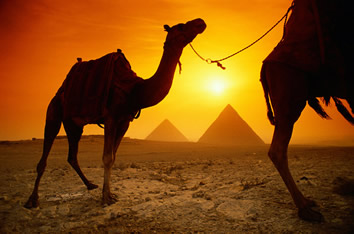
From our comfortable home on the Nile, explore the riches of antiquity as you experience a leisurely cruise through the land of the pharaohs and visit the famous sites to explore their treasures.
Day 1 - 3 - November 18 - 20, 2011
 We arrive at Cairo Airport at noon local time, if flying on EgyptAir We arrive at Cairo Airport at noon local time, if flying on EgyptAir from New York, and drive across the Nile. We stay three nights at the lovely
Mena House Oberoi Hotel from New York, and drive across the Nile. We stay three nights at the lovely
Mena House Oberoi Hotel with its attractive gardens, terraces and fine restaurants, overlooking the grand pyramids at Giza. We will enjoy a reception and our Welcome Dinner at our hotel as we begin our journey into Egyptian history and culture. with its attractive gardens, terraces and fine restaurants, overlooking the grand pyramids at Giza. We will enjoy a reception and our Welcome Dinner at our hotel as we begin our journey into Egyptian history and culture.
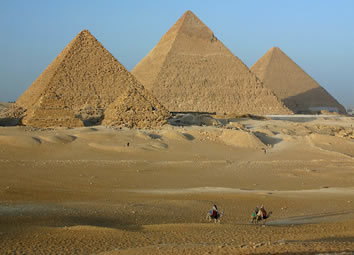
The next morning after breakfast, we take the short drive to see the plateau dominated by the pyramids of Cheops, Chephren and Mycerius, and by the Sphinx. For those who are not claustrophobic, exploring inside one of the pyramids is an awesome experience. We also inspect the beautifully restored solar boat of King Chephren and enter the Valley Temple in which the mummified body of the king rested before being interred in his pyramid.
 In the evening, we will attend the spectacular Sound and Light performance at Giza, unforgettably set against the backdrop of the three great pyramids and the Sphinx. In the evening, we will attend the spectacular Sound and Light performance at Giza, unforgettably set against the backdrop of the three great pyramids and the Sphinx.
The next day we tour Cairo, the greatest metropolis of the Middle East, to explore highlights of Islamic Cairo. In the morning we visit the alabaster Mohammed Ali Mosque on the Citadel overlooking the modern downtown, and the rarely-visited Gayer-Anderson House, the former home of Great Britain's last pasha. In the afternoon we tour the Egyptian Museum, including the fabulous jewels of King Tutankhamon.
Day 4 -5 - November 21 - 22, 2011
 After checking out from our Cairo hotel, we fly to Luxor, where we drive to the harbor and embark on the ss Karim for our 7-night cruise, with full breakfast, luncheon, afternoon tea and dinner daily. After checking out from our Cairo hotel, we fly to Luxor, where we drive to the harbor and embark on the ss Karim for our 7-night cruise, with full breakfast, luncheon, afternoon tea and dinner daily.
During our week's cruise we enjoy our ship's amenities and the ever-changing river scenery of palm trees, rolling hills, golden sand dunes and cultivated land. We'll pass several villages where, from the ship's sundecks, we can view the activities on the riverbank. There are also splendid opportunities for bird watching.  The captain will decide on the exact order and timing of our shore visits, but during the week we will go ashore to visit the temples of Esna, Edfu, Kom Ombo and those of Luxor, as well as the unique pyramid of El Kula. The following gives an example of what we will see on a typical cruise. The captain will decide on the exact order and timing of our shore visits, but during the week we will go ashore to visit the temples of Esna, Edfu, Kom Ombo and those of Luxor, as well as the unique pyramid of El Kula. The following gives an example of what we will see on a typical cruise.
Once aboard our ship we have dinner while sailing upstream to Esna where the ss Karim is raised through a lock some forty feet to the upper level of the river. We spend the night in Esna harbor, then in the morning visit the temple of Khnum, the creator god. Later in the day we visit Edfu, where we drive in horse-drawn carriages to the enormous and best preserved temple in upper Egypt, dedicated to Horus, the sacred falcon god
Day 6 - November 23, 2011
 As we get closer to Aswan, we tie off for a night at Kom Ombo, then in the morning inspect the Roman double temple dedicated to Sobek, the crocodile god, and to Haroeris, a form of the sun god. This temple is most picturesquely sited on the riverbank, a short walk from our dock. As we get closer to Aswan, we tie off for a night at Kom Ombo, then in the morning inspect the Roman double temple dedicated to Sobek, the crocodile god, and to Haroeris, a form of the sun god. This temple is most picturesquely sited on the riverbank, a short walk from our dock.
We reach Aswan in the afternoon and dock for a couple of days in this enchanting town with its near-perfect dry climate and amazing texture of light. You may wish to stroll through the bazaar where Nubian spices, handicrafts and charms are for sale and where gallabiya outfits are custom-made overnight.
Day 7 - November 24, 2011
 Today we will board a traditional boat called a felucca, then tack across the river under a billowing white sail to see the abandoned 6th Century Coptic monastery of Saint Simeon, set on a hillside overlooking the golden desert across the river from the city. We will also stroll through the fine Aswan Botanic Garden on Kitchener Island.
Today we will also visit the Aswan High Dam, which was so controversial when it was built, but which supplies a large part of Egypt’s power, and the unfinished obelisk, whose workers carved out a huge slab of rock, but stopped suddenly, leaving it jutting out from the quarry.
In the evening, Nubian dancers and musicians come on board to entertain us, with one turning into a whirling dervish, who spins fast and continuously for more than 10 minutes!
Day 8 - November 25, 2011
 This morning is free to explore Aswan's bazaar on your own, or to join our optional extension to visit Abu Simbel. The extension includes a 30-minute flight, then a guided tour to view the rock tombs that were raised from the riverbank so they would not be inundated as Lake Nasser filled up behind the High Dam. They rank among the most stupendous monuments of ancient Egypt and mark the most southern extent of the kingdom of the Pharaoh Rameses II.
After returning from Abu Simbel, we set sail back toward Luxor, riding fast on the downstream current while we enjoy the amenities of the ship, including afternoon tea on the deck as we watch the ever-changing life along the river.
Day 9 - November 26, 2011
 Today is mostly a sailing day as we pass sugarcane fields and palm groves that provide a livelihood for the residents of the small villages that dot the riverbank. Sugarcane thrives in the rich soil along the river, so during their harvesting seasons, it may be possible to see tiny narrow-gauge steam engines pulling up to 40 cars of tightly packed sugar cane from the fields to the harbors. Today is mostly a sailing day as we pass sugarcane fields and palm groves that provide a livelihood for the residents of the small villages that dot the riverbank. Sugarcane thrives in the rich soil along the river, so during their harvesting seasons, it may be possible to see tiny narrow-gauge steam engines pulling up to 40 cars of tightly packed sugar cane from the fields to the harbors.
At least once during the trip we will try to leave the other tourists and walk through a local Egyptian market. During one recent trip we observed a mother selling freshly baked bread from a blanket in front of her home, young boys on donkeys following us on the path and practicing their very limited English, and a mayor in his distinguished robes shooing away the youngest children to make sure no-one begged from their honorable visitors.  Contrary to stereotypes, it was also fascinating to see the variety of clothing on both adults and children in this conservative town. Some girls and women wore modest headscarves (usually in very stylish colors!), but others wore western clothes and did not cover their heads. Likewise, while many of the boys and men wore the traditional gallabiya robes, others wore button-down shirts and blue jeans. Contrary to stereotypes, it was also fascinating to see the variety of clothing on both adults and children in this conservative town. Some girls and women wore modest headscarves (usually in very stylish colors!), but others wore western clothes and did not cover their heads. Likewise, while many of the boys and men wore the traditional gallabiya robes, others wore button-down shirts and blue jeans.
Late in the day we pass back through the Esna lock, and arrive in Luxor, where our ship will anchor for two nights. Luxor is the modern name for ancient Thebes, once the capital of Egypt, which consists of two cities lying on the west and east banks of the Nile.
Day 10 - November 27, 2011
 We cross to Western Thebes early in the morning for a busy day of sightseeing, starting with the Tombs of the Nobles. There is no electricity in the tombs so their custodians hold up mirrors to throw light onto walls painted with amazingly bright, lively scenes of everyday life in Egypt 3000 years ago. We drive on to the grand Temple of Queen Hatshepsut, and then to the Valley of the Kings, where we inspect several of the tombs, including that of Tutankhamon (if it is open to visitors). We cross to Western Thebes early in the morning for a busy day of sightseeing, starting with the Tombs of the Nobles. There is no electricity in the tombs so their custodians hold up mirrors to throw light onto walls painted with amazingly bright, lively scenes of everyday life in Egypt 3000 years ago. We drive on to the grand Temple of Queen Hatshepsut, and then to the Valley of the Kings, where we inspect several of the tombs, including that of Tutankhamon (if it is open to visitors).
A typically Egyptian luncheon is provided on the terrace of an inn near Medinet Habu. In the afternoon we stop to see the Ramesseum, with a massive fallen statue of Ramses, and we make a brief photo stop at the two weather-beaten Colossi of Memnon, before returning to the ss Karim for our last night.
Day 11 - November 28, 2011
 This morning we disembark our ship and transfer our luggage to our Luxor hotel where we will stay for our 2-night extension. For those departing to Cairo this evening, we will store your luggage while we visit the temples, then arrange a transfer to Luxor Airport in time for your flight. Rooms will be reserved at a hotel near the Cairo airport until flight time, whether during the night or the next morning. This morning we disembark our ship and transfer our luggage to our Luxor hotel where we will stay for our 2-night extension. For those departing to Cairo this evening, we will store your luggage while we visit the temples, then arrange a transfer to Luxor Airport in time for your flight. Rooms will be reserved at a hotel near the Cairo airport until flight time, whether during the night or the next morning.
Our exploration of Eastern Thebes begins with the immense Temple of Karnak, the largest religious buildings in the world. Ancient Egyptians came to present petitions at more than twenty sites within the temple complex, the most impressive being the vast Hypostyle Hall of Seti I. It has been said that the pyramids are more stupendous, the Coliseum in Rome covers more ground, and the Parthenon of Athens is more serene, but for sheer majesty, this hall with its gigantic columns exceeds them all. It is truly one of the wonders of the world. We also visit the ruins of the impressive Temple of Luxor before returning to our hotel or to the airport.
In the evening, those on the extension will enjoy the sound and light show at the Temple of Karnak. Each "act" of the show is performed in a different part of the temple, with the audience walking from stage to stage.
Day 12 - November 29, 2011
 From Luxor we travel by bus to the Ptolemaic Temple of Hathor at Dendera. This is one of the best preserved of Egypt's ancient temples, built in the 1st Century B.C. on the site of an earlier Old Kingdom temple. Columns with capitals bearing heads of Hathor support the large Hypostyle Hall. Of special interest are staircases that lead onto the roof, where we find several chapels, one with a famous zodiac ceiling, and a kiosk that is a shrine to Osiris. On the south outside wall of the temple are large reliefs, including one depicting Cleopatra, and said by many to be a true portrait of the queen with Caesarion, her son by Julius Caesar. Because Dendera is 30 miles beyond Luxor, most tourists do not visit there, so we are more likely to tour the temple in the company of inquisitive school children and students from nearby colleges than with other foreign tourists. From Luxor we travel by bus to the Ptolemaic Temple of Hathor at Dendera. This is one of the best preserved of Egypt's ancient temples, built in the 1st Century B.C. on the site of an earlier Old Kingdom temple. Columns with capitals bearing heads of Hathor support the large Hypostyle Hall. Of special interest are staircases that lead onto the roof, where we find several chapels, one with a famous zodiac ceiling, and a kiosk that is a shrine to Osiris. On the south outside wall of the temple are large reliefs, including one depicting Cleopatra, and said by many to be a true portrait of the queen with Caesarion, her son by Julius Caesar. Because Dendera is 30 miles beyond Luxor, most tourists do not visit there, so we are more likely to tour the temple in the company of inquisitive school children and students from nearby colleges than with other foreign tourists.
Today we will also be among the few to visit Abydos, one of the most important archaeological sites in Egypt, where we will see the Memorial Temple of Seti I.
Day 13 - November 30, 2011
 This morning we will drive to the Luxor Airport for the one-hour flight to Cairo. We transfer to a hotel near the airport where rooms are reserved until late evening or the morning, based on your departure times. Depending on the time of our arrival in Cairo, we may visit Cairo's famous Khan-el-Khalili bazaar, then have dinner together before our departures for home or for the Siwa Oasis and Alexandria. This morning we will drive to the Luxor Airport for the one-hour flight to Cairo. We transfer to a hotel near the airport where rooms are reserved until late evening or the morning, based on your departure times. Depending on the time of our arrival in Cairo, we may visit Cairo's famous Khan-el-Khalili bazaar, then have dinner together before our departures for home or for the Siwa Oasis and Alexandria.
Day 14 - December 1, 2011
 Those of us on EgyptAir to New York transfer to the airport for our morning nonstop flight, which arrives at John F. Kennedy International Airport in New York in mid-afternoon. After clearing US Immigration and Customs, tour members with destinations in other parts of North America may make suitable connections. (Please confirm flight times with us before making onward reservations.) Those of us on EgyptAir to New York transfer to the airport for our morning nonstop flight, which arrives at John F. Kennedy International Airport in New York in mid-afternoon. After clearing US Immigration and Customs, tour members with destinations in other parts of North America may make suitable connections. (Please confirm flight times with us before making onward reservations.)
Those joining the Siwa Extension (only offered for selected Nile in Style departures) will depart from our hotel near Cairo Airport and head west into the desert toward Siwa today. Because of the remote and unique nature of this excursion, the itinerary is subject to change, but following is the planned itinerary for the Siwa extension:
 Days 1 and 2: Nine hour drive from Cairo to Siwa, with an overnight stop at a seaside resort near El Alamein. Days 1 and 2: Nine hour drive from Cairo to Siwa, with an overnight stop at a seaside resort near El Alamein.
Days 3 and 4: Daily explorations of the village of Shali, surrounding archeological sites, and the lush countryside of the oasis.
Day 5: Drive from Siwa back along the coast to Alexandria, where we stay for two nights.
Day 6: Explore the antiquities of Alexandria, including the National Museum with artifacts from the ancient library and the lighthouse, Pompey's Pillar, Roman catacombs, and the Montazah Gardens.
Day 7: In the afternoon, drive from Alexandria to our hotel near Cairo Airport, so flights can be booked for the night of Day 7 or on Day 8.
Day 8: Departure day for home.
Day 15 - 21 - December 2 - 9, 2011
 Our journey takes us to one of the most isolated of Egypt's oases in the vast Western Desert, 300 miles from the Nile. Siwa was celebrated in antiquity for its Temple of the god Ammon, to which people from all over the Mediterranean region, Asia, and Africa traveled to consult its oracle. Alexander the Great visited it in 331 BC, guided across the desert by crows, and the temple priests crowned him with the rams' horns of Ammon. We will explore the temple as well as many historical sites. We will also ride into the desert to watch sunset over the majestic sands and experience a culture practically unknown to modern travelers. Our journey takes us to one of the most isolated of Egypt's oases in the vast Western Desert, 300 miles from the Nile. Siwa was celebrated in antiquity for its Temple of the god Ammon, to which people from all over the Mediterranean region, Asia, and Africa traveled to consult its oracle. Alexander the Great visited it in 331 BC, guided across the desert by crows, and the temple priests crowned him with the rams' horns of Ammon. We will explore the temple as well as many historical sites. We will also ride into the desert to watch sunset over the majestic sands and experience a culture practically unknown to modern travelers.
The oasis is extremely fertile and its 300,000 date palms and extensive olive groves and fruit orchards have made its inhabitants prosperous. The main town, Shali, used to be fortified, and the oasis tribe of warriors, the zaggala—their name means "club bearer" in the Siwa language—defended it against desert raiders.
 For many centuries, it has been the custom that these stalwart men may not reside in town and may not marry until the age of forty, and they live a carefree bachelor life with each other in the palm groves, cultivating the dates and olives. Scholarly reports from the early 20th century describe some of the rituals and customs of these men, including much drinking of loubki, the highly intoxicating liquor made from the hearts of palm trees, and boisterous dances and songs. Since the 1940s the more conservative Egyptian authorities have forbidden these uninhibited ceremonies (which are reputed to continue in secrecy) but the oasis still is an all-male enclave: all the staff in the hotels, restaurants, cafes, shops and offices are men, most of them wearing the traditional gallabiya robes, and they are courteous and polite to strangers. Women are sequestered in their houses and only rarely does one glimpse a female figure shrouded from head to feet in a blue cotton tarfottet. Even the donkeys that draw the oasis' hundreds of ubiquitous two-wheeled carts are all male! For many centuries, it has been the custom that these stalwart men may not reside in town and may not marry until the age of forty, and they live a carefree bachelor life with each other in the palm groves, cultivating the dates and olives. Scholarly reports from the early 20th century describe some of the rituals and customs of these men, including much drinking of loubki, the highly intoxicating liquor made from the hearts of palm trees, and boisterous dances and songs. Since the 1940s the more conservative Egyptian authorities have forbidden these uninhibited ceremonies (which are reputed to continue in secrecy) but the oasis still is an all-male enclave: all the staff in the hotels, restaurants, cafes, shops and offices are men, most of them wearing the traditional gallabiya robes, and they are courteous and polite to strangers. Women are sequestered in their houses and only rarely does one glimpse a female figure shrouded from head to feet in a blue cotton tarfottet. Even the donkeys that draw the oasis' hundreds of ubiquitous two-wheeled carts are all male!
• Accommodations at fine hotels for three nights in Cairo, on our chartered ship for seven nights, and for one night near Cairo Airport, in double occupancy (single supplement $1100 in 2010);
• All transportation by motorcoaches, cars, horse-drawn carriages, and boats when traveling as a group;
• Arrival and departure airport transfers in Cairo;
• Domestic airport departure taxes when traveling with the group;
• All meals during the main tour except two lunches;
• Wine or soft drinks at the Welcome and Farewell dinners;
• Services of a knowledgeable Hanns Ebensten Travel tour director and an Egyptologist;
• Admission fees to all locations listed in itinerary;
• Meal and driver gratuities;
• Porterage at hotels.
• Airfare between home and Cairo;
• Airfare between Cairo and Luxor (booked as part of international ticket or as a tour option);
• Optional half-day excursion to Abu Simbel including 30-minute flight from Aswan and guided tour (2011 price: $260 per person);
• Optional 2-night extension in Luxor, including hotel, most meals, full day excursion to Dendera and Abydos, and Karnak sound & light show (2011 prices: $800 per person in double occupancy, $1000 in single room);
• Optional 7-night extension to the Siwa Oasis and Alexandria (2011 prices: $2000 per person double occupancy, $2200 in single room);
• Two lunches;
• Tips to Egyptologist, local guides, hotel and ship staffs and gratuity for the Hanns Ebensten Travel tour director;
• International departure taxes;
• Personal items such as alcoholic beverages, telephone calls and laundry.
  |