 


 g(19495)a(1161358))


 
 g(191248)a(1161358))
 


 


 |
 Step into another world in our Northern India extravaganza. From the sights of Delhi to the Taj Mahal and the cities of the Raj, we'll focus on the art, architecture and history of this fascinating and sometime contradictory land. An abundance of famous temples, palaces and forts can easily overwhelm visitors, but we will take a leisurely pace, resting at five star Palace Hotels and concentrating on five areas we can enjoy at ease. We'll spend two days near the Ranthambore National Park, a primary conservation area for tigers, then explore the lovely "pink city" of Jaipur.. We finish our journey with a 2-night stay at the delightful Lake Palace Hotel in Udaipur, the fly back tin Delhi. Step into another world in our Northern India extravaganza. From the sights of Delhi to the Taj Mahal and the cities of the Raj, we'll focus on the art, architecture and history of this fascinating and sometime contradictory land. An abundance of famous temples, palaces and forts can easily overwhelm visitors, but we will take a leisurely pace, resting at five star Palace Hotels and concentrating on five areas we can enjoy at ease. We'll spend two days near the Ranthambore National Park, a primary conservation area for tigers, then explore the lovely "pink city" of Jaipur.. We finish our journey with a 2-night stay at the delightful Lake Palace Hotel in Udaipur, the fly back tin Delhi.
 The vast subcontinent of India has many treasures and we will capture a few of the jewels. Our classic tour of India begins in Delhi as we are swept away to another time and another place. Dotted with hundreds of landmarks, Delhi, India's modern capital, is also a very ancient city. From the beautifully carved 12th century Qutab Minar to the parliament house with its Victorian and 20th century influences, Delhi's architectural gems transcend time. The vast subcontinent of India has many treasures and we will capture a few of the jewels. Our classic tour of India begins in Delhi as we are swept away to another time and another place. Dotted with hundreds of landmarks, Delhi, India's modern capital, is also a very ancient city. From the beautifully carved 12th century Qutab Minar to the parliament house with its Victorian and 20th century influences, Delhi's architectural gems transcend time.
Next we're off to Agra to tour the famous icon of India, the Taj Mahal, We'll also visit the Agra Fort with its 65-foot-tall walls and maze of temples, halls, gardens and mosques. Then we take a two-hour train ride to a lodge near the Ranthambore National Tiger Reserve for two nights and a chance to see tigers in their native environment. We'll spend two days around Jaipur, the lovely "pink city" with its broad avenues and harmonious architecture. Then continue to Udaipur, considered by many to be the most beautiful city in all of India.
 Our journey through India will bring many sensory overloads. With the second largest population in the world but only the seventh largest land mass, cities can be crowded. Add to that a 5000 year history, during which a myriad of religions and cultures have each carved its own place on the face of this subcontinent and you have an amazing diversity of sights, sounds and experiences awaiting you. First you will experience the joys of a long flight. Our journey through India will bring many sensory overloads. With the second largest population in the world but only the seventh largest land mass, cities can be crowded. Add to that a 5000 year history, during which a myriad of religions and cultures have each carved its own place on the face of this subcontinent and you have an amazing diversity of sights, sounds and experiences awaiting you. First you will experience the joys of a long flight.
For our 2011 tour, travelers on non-stop flights from North America will leave home on March 12 and arrive late the following evening in Delhi. We have your room reserved from the night of March 13, 2011, but there are no planned activities until the following morning (besides getting out of your airline seat and enjoying the pleasure of our five-star hotel). Please let us know if you plan to arrive early and need any additional hotel nights.
 • Explore Delhi with its vast and rich history. • Explore Delhi with its vast and rich history.
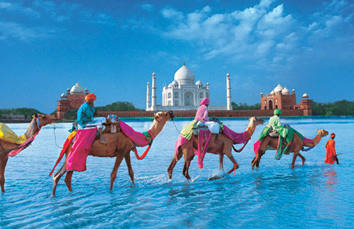
• Watch sunset over the Taj Mahal.
• Visit a tiger preserve, with the possibility of observing the reclusive Bengal tigers in their native habitat.
• See the dreamy "Pink City" of Jaipur and its famous seven gates.
• Visit the romantic and lovely city of Udaipur built around Lake Pichola.
• Relax after a day of touring at sumptuous five-star hotels, including the storied Lake Palace Hotel on an island in Lake Pichola.
• See Mughal history come alive before your eyes.
• Enjoy a four-night post-tour extension to the ancient cities of Varanasi and Khajuraho.
• Explore India, a land of overwhelming sensations!.
Day 1 - March 13, 2011
 Upon arrival in Delhi, a guide will meet you at the airport, and escort you to our hotel, the Taj Mahal in New Delhi. You can rest in your sumptuous quarters, take a walk to shake off the jet lag, hit the pool or relax and rest for our India adventure. The Taj Mahal Hotel is a member of the Leading Hotels of the World and offers many amenities to help you recover from the long flight. (NOTE: hotels listed here have been reserved, but all hotels are subject to change.) Upon arrival in Delhi, a guide will meet you at the airport, and escort you to our hotel, the Taj Mahal in New Delhi. You can rest in your sumptuous quarters, take a walk to shake off the jet lag, hit the pool or relax and rest for our India adventure. The Taj Mahal Hotel is a member of the Leading Hotels of the World and offers many amenities to help you recover from the long flight. (NOTE: hotels listed here have been reserved, but all hotels are subject to change.)
Day 2 - March 14, 2011
 Today we will explore the fascinating and sometimes fast-paced city of Delhi on a full-day tour. In the morning we visit Old Delhi and see the Raj Ghat, a simple memorial to Mahatma Gandhi. We will drive past the Red Fort, a massive structure built with red sandstone and a magnificent symbol of Mughal elegance and design. Today we will explore the fascinating and sometimes fast-paced city of Delhi on a full-day tour. In the morning we visit Old Delhi and see the Raj Ghat, a simple memorial to Mahatma Gandhi. We will drive past the Red Fort, a massive structure built with red sandstone and a magnificent symbol of Mughal elegance and design.
Then we'll visit India's largest mosque, Jama Masjid, built in the 17th century. It took 5000 artisans fourteen years to complete and is a unique architectural piece of the Mughal period. It has three gateways, four towers and two minarets as tall as 120 feet. Nearby is Chadni Chowk, once an imperial avenue down which Shah Jahan rode at the head of lavish cavalcades and today is often the scene of world's most picturesque traffic jam with every kind of vehicle imaginable.
Old Delhi exhibits the traditions of the Mughal emperors who presided there, and New Delhi, the British capital during colonial days, shows off the more modern side of India. In the afternoon we leave the walled city of Old Delhi behind to explore the sights of New Delhi.
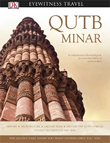
 However, even in New Delhi are some very old monuments. We'll see the 12th century Qutub Minar, the highest stone tower in all of India. It was erected by Qutub-ud-din Aibak as a victory tower in 1199. It is considered one of the finest Islamic structures ever raised, and Delhi's recognised landmark, even though it was built with the columns from 27 Hindu and Jain temples. Gracefully hand-carved along its entire height of 234 feet, the tower stands near the Iron Pillar, which has withstood the ravages of time and not rusted in over 1500 years. However, even in New Delhi are some very old monuments. We'll see the 12th century Qutub Minar, the highest stone tower in all of India. It was erected by Qutub-ud-din Aibak as a victory tower in 1199. It is considered one of the finest Islamic structures ever raised, and Delhi's recognised landmark, even though it was built with the columns from 27 Hindu and Jain temples. Gracefully hand-carved along its entire height of 234 feet, the tower stands near the Iron Pillar, which has withstood the ravages of time and not rusted in over 1500 years.
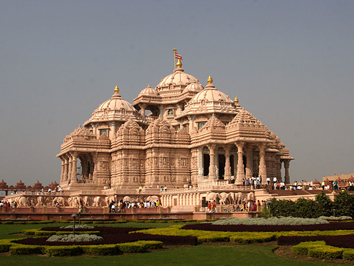
We'll visit the graceful mausoleum of the Mughal Emperor Humayun and drive past the modern Birla Temple, built in 1938. The uniqueness of this beautiful temple lies in the fact that it is open for all; it does not recognise any social or religious stratas. This was the condition on which Mahatma Gandhi agreed to inaugurate the temple. The temple houses idols of several deities, but is mainly dedicated to Laxmi (the goddess of wealth) and Narayana (the preserver). We will also see the President's house, the Parliament house and the India Gate war memorial.
Day 3 - 4 - March 15 - 16, 2011
 Today we transfer to Agra and the Gateway Hotel (ex. Taj View Hotel), a lovely property from which we may gaze at the great monument at our leisure. Agra was established in 1475 by Badal Singh and came into its own when Sikander Lodhi of the Lodhi dynasty chose it for his capital because of its proximity to the Yamuna River. In the mid-16th and early 17th centuries, Agra witnessed a frenzied building activity and it was during this time that the symbol of love, the Taj Mahal, was built. The buildings made during this era were purely in the contemporary Mughal style and of very high quality. Besides the monuments, Agra is known for the masterpieces of craftsmen recreating the glory of the Mughal period and for the Mughlai cuisine, the aroma of which fills the narrow lanes of Agra. Today we transfer to Agra and the Gateway Hotel (ex. Taj View Hotel), a lovely property from which we may gaze at the great monument at our leisure. Agra was established in 1475 by Badal Singh and came into its own when Sikander Lodhi of the Lodhi dynasty chose it for his capital because of its proximity to the Yamuna River. In the mid-16th and early 17th centuries, Agra witnessed a frenzied building activity and it was during this time that the symbol of love, the Taj Mahal, was built. The buildings made during this era were purely in the contemporary Mughal style and of very high quality. Besides the monuments, Agra is known for the masterpieces of craftsmen recreating the glory of the Mughal period and for the Mughlai cuisine, the aroma of which fills the narrow lanes of Agra.
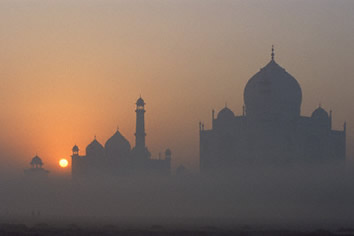
 No trip to India would be complete without a visit to the vast and unmistakable icon of India, the Taj Mahal, selected in 2007 as one of the New Seven Wonders of the World. This mythic structure with its history of romance and survival from the ravages of various marauders threatens to underwhelm visitors who have lived in the shadow of its hype. But its symmetry, its purity, the whiteness, the elegance of its curves, the majesty of its size and silhouette can still surprise and astound visitors. It will be our backdrop throughout our stay but we will enter its graceful walls at sunset, the most beautiful time of the day for viewing. No trip to India would be complete without a visit to the vast and unmistakable icon of India, the Taj Mahal, selected in 2007 as one of the New Seven Wonders of the World. This mythic structure with its history of romance and survival from the ravages of various marauders threatens to underwhelm visitors who have lived in the shadow of its hype. But its symmetry, its purity, the whiteness, the elegance of its curves, the majesty of its size and silhouette can still surprise and astound visitors. It will be our backdrop throughout our stay but we will enter its graceful walls at sunset, the most beautiful time of the day for viewing.
During our stay we will also visit the Agra Fort, which evolved during the reigns of three Mughal Emperors. Here we can witness the apparent transition of the stern citadel raised by Akbar to the lavishly beautiful shimmering white palaces built by Shah Jahan.
Day 5 - 6 - March 17 - 18, 2011
 Today we drive to a train station, then take a 2-hour train ride to Sawai Madhopur, the entry point for the famous Ranthambore National Park. We then drive a short distance to our home for the next two nights, the Taj Lodge.
The Park is one of the prime examples of Project Tiger's conservation efforts in Rajasthan. It covers an area of over 400 square kilometers with many steep crags embracing a network of lakes and rivers. Atop one of these hills, the 10th century Ranthambore Fort stands like a silent sentinel. The terrain is a blend of impregnable forests and open bush land.
 Ranthambore is best known for its reclusive tiger population, but there are also many panthers as well. Kachida Valley is considered to be the place to sight these rather elusive cats. One can also find marsh crocodiles, hyenas, jungle cats and sloth bears. The avian population includes black storks, quails, Bonelli's eagles and painted storks. During the winter months, the park attracts a lot of migratory birds, including a variety of ducks. Ranthambore is best known for its reclusive tiger population, but there are also many panthers as well. Kachida Valley is considered to be the place to sight these rather elusive cats. One can also find marsh crocodiles, hyenas, jungle cats and sloth bears. The avian population includes black storks, quails, Bonelli's eagles and painted storks. During the winter months, the park attracts a lot of migratory birds, including a variety of ducks.
The best time to visit the park is between October and April, with early morning and late afternoon the best times to view game. It is the ideal park for wildlife photography. With so much to see and plenty to do, we will enjoy a leisurely two nights here and explore not only the park but the nearby fort and other attractions.
Day 7 - 8 - March 19 - 20, 2011
 After one final early morning game viewing drive, we will have breakfast at our lodge, then drive about four and a half hours to Jaipur. We'll check into our rooms at the Jai Mahal Palace Hotel, then the rest of the day will be free.
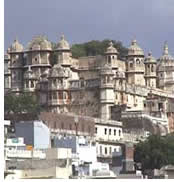
Jaipur is called the Pink City because most of its buildings are of sandstone, and was chosen by Maharaja Sawai Jai Singh II (1693-1743) for his capital. It still is the vibrant capital of the desert state of Rajasthan. Surrounded on all sides by rugged hills, crowned with forts and enclosed by embattled walls, Jaipur is a must see for travelers to India.
 The Old City, the actual Pink City, is a great place to wander around. Maharaja Man Singh II had the whole city painted pink when the Prince of Wales, later Edward VII, visited Jaipur in 1876. Today, every home within the old city is obliged by law to maintain this facade. Fabulous, tall houses with latticed windows line the narrow streets of the old city, their rose pink color lending enchantment to a scene which is almost magical at sunset. The Old City, the actual Pink City, is a great place to wander around. Maharaja Man Singh II had the whole city painted pink when the Prince of Wales, later Edward VII, visited Jaipur in 1876. Today, every home within the old city is obliged by law to maintain this facade. Fabulous, tall houses with latticed windows line the narrow streets of the old city, their rose pink color lending enchantment to a scene which is almost magical at sunset.
We will visit the Amber Fort, which was the ancient capital of the state until 1728. While in Jaipur, we will also explore Jagmandir or the "Hall of Victory", glittering with mirrors, as well as Jai Mahal and the Temple of Kali. Jaipur is like an endless museum. The city offers an amazing variety of crafts. Jewellers here still fashion the beautiful enamel-on-gold pendants, studded on the reverse side with precious stones or pearls and turquoise. Jaipur's lacquer bangles are also famous all over the world.
Day 9 - 10 - March 21 - 22, 2011
We fly from Jaipur to Udaipur on an early morning 45-minute flight. Udaipur, one of the most romantic places in India, is situated around the shimmering clear blue lakes which whisper the mood of a bygone era. Founded in 1567 by Maharana Udai Singh on the advice of a sage, Udaipur was the last of the numerous Mewar capitals. The city acquires its scenic beauty from the three lakes, Pichola, Fateh Sagar and Udai Sagar, that make it a lovely oasis in the desert. Full of enchanting tales, Udaipur has a remarkable past, with episodes of heroism and splendor. Our home base as we explore this city will be the exquisite Lake Palace Hotel, one of the most famous hotels in all of Asia.
We will visit the vast City Palace, whose walls stretch for more than a mile along the shore of Lake Pichola, and Jagdish Temple, one of the largest and most popular Vishnu temples in northern India. We'll take a drive around the Fateh Sager Lake and see the Sahelion Ki Badi (Queen's resort). We'll also have time to just wander through the hustle and bustle of the old market, including locations where the James Bond film Octopussy were filmed.
 In the late afternoon, we'll take a relaxing boat ride on the placid waters of Lake Pichola, have the opportunity to witness evening rituals on the bathing ghats (steps leading into the lake), and watch the sun set against the backdrop of the magnificent palaces. In the late afternoon, we'll take a relaxing boat ride on the placid waters of Lake Pichola, have the opportunity to witness evening rituals on the bathing ghats (steps leading into the lake), and watch the sun set against the backdrop of the magnificent palaces.
The next day we'll take a full day excursion to Ranakpur, one of the five holy places of the Jain community, with its 15th century temple complex famous for its marvellous carvings. In spite of being built in 1460, these temples of sparkling marble are well preserved. Situated in the lovely valley of Aravalli, the mood here is quiet and the view is picturesque. Each temple is unique. One has 1444 columns, another exemplifies simplicity. This evening we will enjoy our Farewell Dinner back in Udaipur.
Day 11 - March 23, 2011
 In the morning we transfer to the airport for our two hour flight back to Delhi. After check in at our hotel, the rest of the day is at leisure. Perhaps you need to do some last minute shopping. Or enjoy our fine hotel before a long trip home. If you have a special request please forward it to us and we will try to accommodate you. Hotel rooms are reserved through the morning of Day 12, but depending on flight schedules, you may wish to leave in the late evening of Day 11 (March 23, 2011) or early morning on Day 12 (March 24).
Day 12 - March 24, 2011
Our main tour ends this morning, but those joining our post-tour extension will fly to Varanasi today.
We hope you have enjoyed our Grand Tour of India. We look forward to seeing you again soon!
Post-tour extension to Varanasi and Khajuraho.
Many of our travelers will join our post-tour extension to two of India's most sacred cities to enhance their tour of India and to experience more of the richness of Indian culture. We will begin the extension with a morning flight to Varanasi, where we will spend two nights.
 Varanasi (formerly called Benares) is situated on the banks of the holy Ganges River and is presided over by Lord Shiva. It is called the Eternal City and is distinguished by the many "ghats" along the riverside. (A ghat is a broad flight of steps that provides access to the water, especially for bathing). From time immemorial Varanasi has been a seat of learning and an important religious center for Hindus. It is also one of the most sacred places of pilgrimage, being visited by millions of people every year. In addition to its role in Hinduism, Varanasi also holds an important place in Buddhism, since Buddha's first sermon was given nearby. Varanasi (formerly called Benares) is situated on the banks of the holy Ganges River and is presided over by Lord Shiva. It is called the Eternal City and is distinguished by the many "ghats" along the riverside. (A ghat is a broad flight of steps that provides access to the water, especially for bathing). From time immemorial Varanasi has been a seat of learning and an important religious center for Hindus. It is also one of the most sacred places of pilgrimage, being visited by millions of people every year. In addition to its role in Hinduism, Varanasi also holds an important place in Buddhism, since Buddha's first sermon was given nearby.
 From Varanasi we'll fly to Khajuraho, where we will spend two nights in this ancient capital of the Chandela Rajput Empire, built over one thousand years ago. We'll also tour some of the temples built between the 9th and 12th centuries. Not only are these temples of the "nagara" style in splendid condition, they are famous for their beautifully sculpted surfaces which are covered in exquisitely detailed erotic content. This has been such a popular stop that we have made it a two-night stay instead of just one night. From Varanasi we'll fly to Khajuraho, where we will spend two nights in this ancient capital of the Chandela Rajput Empire, built over one thousand years ago. We'll also tour some of the temples built between the 9th and 12th centuries. Not only are these temples of the "nagara" style in splendid condition, they are famous for their beautifully sculpted surfaces which are covered in exquisitely detailed erotic content. This has been such a popular stop that we have made it a two-night stay instead of just one night.
We will fly back to Delhi in the early afternoon. Since many flights to North America and Europe depart around midnight, no hotel is included for this night. However, we will have a day room available at a hotel in Delhi so you can freshen up for the flight home. For those flying out the following day or later, please let us know if you would like to add additional hotel nights.
• Transfers between Delhi Airport and hotel on arrival and departure;
• All surface transportation within India as outlined in tour itinerary in air-conditioned mini-coach or train;
• Flights from Jaipur to Udaipur, and from Udaipur to Delhi, including airport departure taxes;
• Five Star Superior hotels or hunting lodge each night, with private bath, in double occupancy;
• Two nights at the world-famous Lake Palace Hotel in Udaipur, surrounded by its own lake.
• Daily breakfast and six dinners, including wine at Welcome and Farewell dinners, plus two lunches while at Tiger Reserve;
• Admission to sites described in itinerary;
• Services of English-speaking Indian guides, plus Hanns Ebensten Travel tour director (with minimum number of participants);
• All hotel service charges, government taxes, porterage, and gratuities for included meals.
• International flights to and from Delhi;
• Visas for visting India (information about obtaining a visa will be sent about 4 months before departure);
• Camera/video fee which is charged at some monuments;
• Lunches and dinners not described as being included;
• Personal items including: alcoholic beverages, snacks, laundry, and telephone calls;
• Gratuities for guides.
 |
Jewels of India Tour Itinerary
|
Date |
Destination |
| 13 March |
Delhi |
| 14 March |
Delhi |
| 15 March |
Agra and the Taj Mahal |
| 16 March |
Agra and the Taj Mahal |
| 17 March |
Ranthambore |
| 18 March |
Ranthambore |
| 19 March |
Jaipur |
| 20 March |
Jaipur |
| 21 March |
Udaipur |
| 22 March |
Udaipur |
| 23 March |
Delhi |
| 24 March |
Delhi / Home / Varanasi and Khajuraho Extension |
| 25 March |
Varanasi |
| 26 March |
Khajuraho |
| 27 March |
Khajuraho |
| 28 March |
Delhi / Home |
|
|
|
 
 The vast subcontinent of India has many treasures and we will explore a few of its jewels. From the sights of Delhi to the Taj Mahal, we'll focus on the art, architecture and history of this fascinating and sometimes contradictory land. The abundance of fascinating temples, palaces and forts can easily overwhelm visitors but we will take a leisurely pace, resting at five star hotels and concentrating on five areas that we can enjoy with ease. We'll spend two days near the Ranthambore National Park, a primary conservation area for tigers. We will also explore the lovely "pink city" of Jaipur. Our last stop is at Udaipur where we take an excursion to the temples of Ranakpur, a 15th century delight of columns and carvings. The vast subcontinent of India has many treasures and we will explore a few of its jewels. From the sights of Delhi to the Taj Mahal, we'll focus on the art, architecture and history of this fascinating and sometimes contradictory land. The abundance of fascinating temples, palaces and forts can easily overwhelm visitors but we will take a leisurely pace, resting at five star hotels and concentrating on five areas that we can enjoy with ease. We'll spend two days near the Ranthambore National Park, a primary conservation area for tigers. We will also explore the lovely "pink city" of Jaipur. Our last stop is at Udaipur where we take an excursion to the temples of Ranakpur, a 15th century delight of columns and carvings.
How do I get to India?
As of late 2010, non-stop flights between North America and Delhi are offered by Continental (from Newark), Air India (from Newark), Air India (from JFK and Chicago), and American (from JFK and Chicago), and American (from Chicago). There are numerous one-stop connections via European hubs. Delta (from Chicago). There are numerous one-stop connections via European hubs. Delta and others offer additional non-stop flights between North America and Mumbai (the Indian name for Bombay), but these will require an overnight stay in Mumbai and a domestic connection to Delhi. and others offer additional non-stop flights between North America and Mumbai (the Indian name for Bombay), but these will require an overnight stay in Mumbai and a domestic connection to Delhi.
When should I plan to arrive in India?
 We have reserved a hotel room for everyone starting on the evening of Day 1 (the starting day for the trip), and the first group activity is a city tour of Delhi starting the morning of Day 2. Most North American travelers will leave home on the day before Day 1, arriving Delhi late evening on Day 1 or early morning on Day 2. (In 2011, this means departing North America on March 12 and arriving Delhi late on March 13 or a little after midnight on March 14.) If anyone wishes to arrive a day or two early to be refreshed for our touring, we can reserve extra hotel nights for you.
Those taking part in the Varanasi / Khajuraho extension will depart from Delhi following our main tour on March 24, for two nights in Varanasi and two nights in Khajuraho, before returning to Delhi on March 28 for flights home late night on March 28 or early on March 29. We have day rooms in Delhi on March 28 before these flights, but extra hotel nights can be added for anyone staying longer.
For what date should I book my departure flight from India?
Our trip officially ends with breakfast on the morning of Day 12. However, since many international flights from Delhi depart very late at night or early morning, there are no group activities scheduled after noon on Day 11, allowing for departures on Day 11 or Day 12. In 2011, Day 11 is March 23 and Day 12 is March 24. (Our Farewell Dinner will be in Udaipur on Day 10.)
What is included in the extension to Varanasi and Khajuraho, and what is the cost?
 For those participants who have a little more time to spend in India, we are offering a four night extension to Varanasi and Khajuraho.
Varanasi (once called Benares) is visited daily by thousands of Hindi pilgrims who come to bathe in the sacred Ganges River. During our tour we will see many of the ghats (bathing sites) from both the shore and from a boat, and we will also visit nearby Sarnath, where Siddharth Gautama, the original Buddha, gave his first sermon.
 Khajuraho is famed for its 1000-year-old Chandela Dynasty erotic temples, which have been better preserved than most other ancient temples due to the city's remote location. During our tour of the city, we will see that the sacred and the profane were one when this city was at its peak of prominence. Khajuraho is famed for its 1000-year-old Chandela Dynasty erotic temples, which have been better preserved than most other ancient temples due to the city's remote location. During our tour of the city, we will see that the sacred and the profane were one when this city was at its peak of prominence.
The extension price includes two nights in Varanasi and two nights in Khajuraho, as well as breakfast each day; inter-city transportation by air (Delhi-Varanasi-Khajuraho-Delhi); local transportation; and guided tours in Varanasi and Khajuraho.
Please note that due to the limited transportation options to these cities, our itinerary is subject to change, but we will ensure that you are able to experience the highlights of these two historic cities.
I'm traveling alone. Will everyone else be in couples?
 Most of our trips draw more single travelers than couples. When couples do join us, it's usually because they're looking forward to interacting with a gay group; if they wanted a holiday by themselves, they wouldn't have signed up to travel with us. Furthermore, the activities included with our trips serve as natural ice-breakers. Within a day, you'll be traveling with friends.
You don't need to pay the single supplement if you're traveling alone. We'll be happy to match you with a roommate. Pay the single supplement only if you want a bedroom to yourself.
Do I need to speak a foreign language for your overseas trips?
No. Most people who travel abroad with us don't speak the language. But we encourage you to brush up on any language skills you have that are relevant for the area you're going to, and to learn a few basic phrases, such as hello and thank you, in the local language. You'll find even a few words make a big difference in your interactions with local people.
Is it any problem if a straight friend joins me on a trip?
 Each year we designate some of our trips as being for "gay men, lesbians, and friends." so we encourage any of our straight friends who enjoy traveling with an open-minded group to join these tours.
In addition, many of our trips are designated for gay men only or for gay men and lesbians. The Hanns Ebensten Travel was founded because, even these days, gay men and lesbians sometimes encounter a cool reception from people who aren't gay, and many of us would rather take a vacation in an atmosphere where that's not an issue. Our groups are also mostly small and intimate (some with as few as six participants) and the camaraderie is as important as the scenery. So while we occasionally welcome friends and family to join us, we keep a majority of our groups designated for gay men. Our mission from the beginning has included offering trips for gay men (and sometimes lesbians) to be together without the pressures they may experience at home (especially in smaller cities) and in their jobs. At the same time, we have also found that sometimes a wider mix of participants and personalities can make for a great trip so we offer several "all welcome" tours each year.
So your open-minded straight friends are certainly welcome to travel with us on all-welcome trips. We think they'll have a great time!
 

 
 



|
|