|
Mediterranean Cruise on Celebrity Equinox
12 nights roundtrip cruise from /to Barcelona, Spain
August 21–September 2, 2013
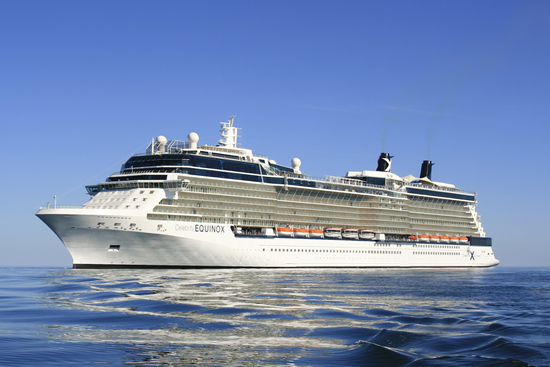
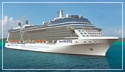
Celebrity's Equinox
 Join Pied Piper Travel on this unique voyage to France, Italy and Croatia and the beautiful Mediterranean. Our cruise will sail round trip out of gay-friendly Barcelona on the new ultra-stylish Celebrity ship, Equinox
 ! You'll bask in the golden Mediterranean sun while you visit popular ports of call. This Pied Piper gay group cruise will be a perfect combination of culture, breathtaking natural landscapes and modern urban capitals. ! You'll bask in the golden Mediterranean sun while you visit popular ports of call. This Pied Piper gay group cruise will be a perfect combination of culture, breathtaking natural landscapes and modern urban capitals.
All this is yours while you are pampered with gracious service, gourmet dining, and numerous venues for entertainment on the brand new and most up-to-date luxury cruise ship.  
Celebrity's Equinox
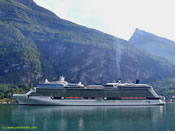 The very essence of luxury, this is Celebrity Equinox. Shimmering in sophistication from bow to stern, she will exceed your expectations as soon as you step aboard. Delight in your choice of ten exceptional dining venues; relax in spacious and well appointed accommodations; or let the grass between your toes take you out to sea at the unprecedented Lawn Club. With every imaginably comfort, along with Celebrity's unrivaled guest services, you are bound for greatness no matter your destination. The very essence of luxury, this is Celebrity Equinox. Shimmering in sophistication from bow to stern, she will exceed your expectations as soon as you step aboard. Delight in your choice of ten exceptional dining venues; relax in spacious and well appointed accommodations; or let the grass between your toes take you out to sea at the unprecedented Lawn Club. With every imaginably comfort, along with Celebrity's unrivaled guest services, you are bound for greatness no matter your destination.
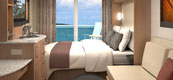
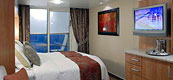
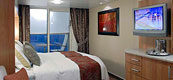
Celebrity Equinox upholds the standards of Celebrity's Solstice class with the tradition of signature service, quality dining and personal amenities. Like others in its class, the Equinox offers wireless Internet, flat-screen televisions in large staterooms, plush bedding and additional space for storage.
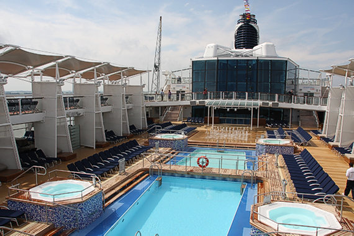
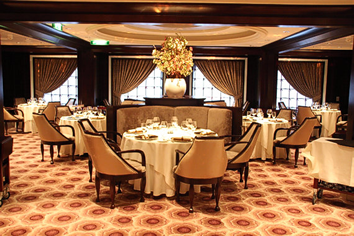
Spa enthusiasts staying within the AquaClass category of veranda staterooms are just a few steps away from the relaxing AquaSpa, which encompasses a solarium with lap pool, Persian Garden with steam rooms and sauna, and private treatment rooms. The AquaSpa Café is also located on the premises and serves light, healthful dishes, and AquaClass guests gain exclusive, complimentary access to Blu, a 130-seat specialty restaurant. Eight additional dining venues are available, including the Silhouette Dining Room, the casual Oceanview Café and Bar and Murano, just to name a few.
In the evenings, the Equinox offers an impressive array of evening entertainment. Take in a fabulous production in the Equinox Theatre, enjoy a late-night comedy show at Celebrity Central or explore the ship's bars and lounges, each with its own unique atmosphere. One of the ship's most interesting features is The Lawn Club that boasts a freshly manicured lawn of real grass and casual outdoor activities. Overlooking this park-like area is the Patio on the Lawn, which is the perfect place for relaxing with a good book and cup of gourmet coffee.
Barcelona, Spain
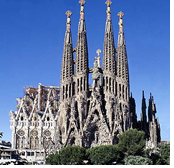
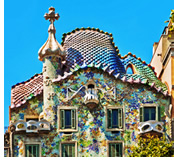 There's nothing quite like Barcelona. Especially if you consider the architecture. The city lays claim to its very own form of Art Nouveau, known as Modernisme. The Sagrada Familia Basilica is perhaps the best example of this beautiful and interesting brand of architecture, with its bold color, beautiful tile-work and swirling lines. At the same time, many find the work at the Picasso Museum and the cathedrals of the Gothic Quarter equally inspiring. There's nothing quite like Barcelona. Especially if you consider the architecture. The city lays claim to its very own form of Art Nouveau, known as Modernisme. The Sagrada Familia Basilica is perhaps the best example of this beautiful and interesting brand of architecture, with its bold color, beautiful tile-work and swirling lines. At the same time, many find the work at the Picasso Museum and the cathedrals of the Gothic Quarter equally inspiring.
Barcelona is the most important city of Catalonia as well as being the administrative capital. With a population of approximately 3 million, it is the second largest city in Spain and the largest on the Mediterranean coast.
Nestled between the Pyrenees and the Mediterranean, Barcelona enjoys a mild sunny climate. It's a bustling city, an important sea port and center of commerce.
The people are lively and active, immensely proud of their Catalonian culture, as seen by the use of their own Catalonian language in books, newspapers, television and radio programs.
Cathedral of Barcelona
The city's superb 600-year-old gothic cathedral lies at the heart of the Barri Gotic.
Church of La Sagrada Familia
La Sagr ada Famili a on Calle de Cerdena, is one of the architect Gaudí's most famous works. The Cathedral, begun in 1882 is still under construction although Gaudí died in 1926. Gaudí is buried in the crypt. It is possible to take an elevator to the top of one of the towers for a panoramic view.
 La Pedrera La Pedrera
Barcelona's great architect Antonio Gaudí designed this commercial and residential building.
Las Ramblas
stretching from the water-front to Plaça de Catalunya, this delightful, tree-lined boulevard is the center of activity. A variety of shops, particularly flower stalls, are to be found here making it a pleasant place to stroll along or watch the world go by from one of the many side-walk cafes.
Gothic Quarter
is the older part of the City, mainly a pedestrian area. The buildings here date from the 13th century and create a truly medieval atmosphere. Cathedral of Santa Eulalia, located within the Gothic Quarter, was built between 1298 and 1454, although the main facade and the spire were 19th century additions. The Cathedral was named after the 13 year old martyr, whose sarcophagus can be seen, carved in bas-relief, depicting her torture and execution. The Cathedral is built in classic, Catalonian gothic style, with 500 year old stained-glass windows.
Mirador Del Alcalde
This viewpoint near the 1992 Olympic Ring offers panoramic views of the city and harbour.
Montserrat
The 1,000-year-old Benedictine Abbey is the region's spiritual centre surrounded by mountains and home to the famed "Black Madonna."
Nice (Villefranche), France
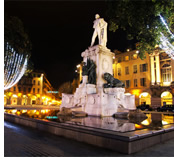 The city of Nice is situated at the foot of the Alps. This jewel of the French Riviera is home to some of the world's most luxurious hotels and terraced cafés. Stroll the ultra-famous Promenade des Anglais or see masterpieces by Matisse, Renoir, Monet and Chagall in one of Nice's many museums. The city of Nice is situated at the foot of the Alps. This jewel of the French Riviera is home to some of the world's most luxurious hotels and terraced cafés. Stroll the ultra-famous Promenade des Anglais or see masterpieces by Matisse, Renoir, Monet and Chagall in one of Nice's many museums.
Villefranche is a small, coastal town, located in the heart of the French Riviera, which stretches from St. Tropez to Menton on the Italian border, and includes the cosmopolitan towns of; Cannes, Nice and Monte Carlo.
The Riviera, often referred to as the Cote d'Azur, with its beautiful beaches and pleasant climate, has developed into a major tourist resort. The hill-sides surrounding the Cote d'Azure contain many small, fortified towns which still retain much of their medieval character.
Villefranche is a charming little town, nestled against the hillside, overlooking the bay between Nice and Monte Carlo. The pace here is slow and the atmosphere restful.
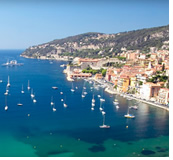 Cannes, Cannes,
approximately 28 miles from Villefranche, was the first resort on the Côte d'Azur. Each May it attracts members of the 'Jet Set' for the famous Film Festival. The chic and the elegant display their wealth in the exclusive hotels that line the sea-front along Boulevard de la Croisette.
Nice,
just 3 miles from Villefranche, is known as the capital of the French Riviera, its main attraction being its location, right in the middle of the Cote d'Azur. The beach, spanning the Baie de Anges, is lined by the Promenade des Anglais, built in 1824 and named for the British who paid for its construction.
Monte Carlo,
some 6 miles from Villefranche, belongs to the Principality of Monaco and is governed independently, although the way of life is distinctively French. Known as the play-ground of the rich, it is famous for its wealth. Monaco is ruled by Prince Albert II, a direct descendant of the Grimaldi family, who have reigned since 1275.
Florence / Pisa (Livorno), Italy
 The beautiful Italian seaport of Livorno is the gateway to Florence, Pisa and Tuscany's vast wine country. Pisa is most noted for its famous marble bell tower, the Leaning Tower of Pisa, which has tilted 14 feet since 1370. The beautiful Italian seaport of Livorno is the gateway to Florence, Pisa and Tuscany's vast wine country. Pisa is most noted for its famous marble bell tower, the Leaning Tower of Pisa, which has tilted 14 feet since 1370.
Livorno belongs to the region of Tuscany, which incorporates the west coast area of central Italy and includes the historic and culturally significant towns of Florence and Pisa.
The Tuscan climate is typically Mediterranean, the topography a combination of fertile valleys and sloping green hills on which Cypress trees thrive. The beauty of the countryside is featured in many paintings created by some of the most famous renaissance artists who flocked to Florence during this period.
The people of Tuscany are noted for their charm, generosity and taste for good living. They take great pride in their art and architectural treasures.
Livorno developed as a trading port during the 15th century and reflected the decline of Pisa as a result of the silting up of the River Arno. Today trade includes; timber, marble, alabaster and automobiles, as well as various craft items, most of which is derived from Florence.
 Pisa Pisa
is situated a little inland, approximately 12 miles from Livorno, on the banks of the River Arno. It was once a republic and city of commercial importance, and bears witness to this period with it's majestic buildings and art works, the most famous being the Leaning Tower.
Florence,
also found on the River Arno some 62 miles from Livorno, dates from 800 BC when a settlement was first established at a fording point on the river. Florence is a beautiful city, small and compact with narrow streets and large open squares. It is the 6th largest city in Italy, with a population of 500,000. The old quarter, with it's renaissance architecture, paintings and sculptures, could almost be described as a living museum.
Rome (Civitavecchia), Italy
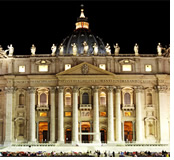 Once the center of the ancient world from which emperors ruled over nearly all of western civilization for hundreds of years, Rome is still considered by many to reign over all other European destinations. Here you can breathe the air once breathed by great Roman gladiators in the ancient halls of the Colosseum. Gaze upon the very ceilings Michelangelo painted at the Sistine Chapel. Or visit a monument to both size and faith, St. Peter's Basilica, the largest church ever built. Once the center of the ancient world from which emperors ruled over nearly all of western civilization for hundreds of years, Rome is still considered by many to reign over all other European destinations. Here you can breathe the air once breathed by great Roman gladiators in the ancient halls of the Colosseum. Gaze upon the very ceilings Michelangelo painted at the Sistine Chapel. Or visit a monument to both size and faith, St. Peter's Basilica, the largest church ever built.
Colosseum
Completed 80 A.D., the circus was home to centuries of gladiatorial combats and featured 76 numbered entrances, marble seats and subterranean passages, where animals and apparatus were kept. The arena floor could be flooded to host naval combats.
Roman Forum
The ruins of the forum stand in mute testimony to what Byron described as the "grandeur that was Rome".
Sistine Chapel
The gem of the Vatican Museum is the celebrated chapel that is home to Michelangelo's frescoes 'The Creation' and 'The Last Judgement'.
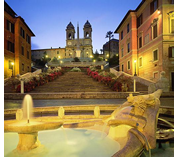 Spanish Steps Spanish Steps
The heart of Rome's old Bohemian Quarter (Keats and Shelley lived nearby), the steps take their name from the 16th century Spanish Embassy to the Holy Sea. Today the area surrounding Piazza Espagna is the city's chic shopping district.
St.Peter's Basilica
By far the largest church in the world, St. Peter's Basilica took more than 100 years to build. Some of the greatest figures of the Renaissance were employed in its creation, from Bramante and Bernini to Michelangelo and Raphael.
Trevi Fountain
Blue-green water cascades over the Baroque figures of Rome's most famous fountain. Follow custom and toss a coin into the fountain, a gesture that insures your return to the Eternal City.
Vatican City
The spiritual and administrative centre of Roman Catholicism is also one of the smallest independent states in the world. The Vatican mints its own coins, prints its own stamps, and maintains its own army of Swiss Guards.
Naples/Capri, Italy
 Located on the southern coast of Italy, Naples has spectacular scenery that attracts artists from around the world. From this key spot, you can embark on a trip to the ruins of Pompeii or shop the many boutiques of Sorrento. You may work up an appetite for one of Naples' greatest inventions - pizza - invented to honor the Queen of Italy in 1889. Located on the southern coast of Italy, Naples has spectacular scenery that attracts artists from around the world. From this key spot, you can embark on a trip to the ruins of Pompeii or shop the many boutiques of Sorrento. You may work up an appetite for one of Naples' greatest inventions - pizza - invented to honor the Queen of Italy in 1889.
Naples is the third largest city in Italy, with a population of over 1.5 million. It lies at the foot of a range of low hills on the west coast of southern Italy. Since the destruction inflicted during World War II, Naples has become an important industrial and commercial center. The Bay of Naples makes it Italy's second most important sea port, surpassed only by Genoa.
The Neapolitans have a great fondness for music and with such songs as 'Santa Lucia', 'O Sole Mio' and 'Funiculi Funicla', the City's music has become familiar throughout the world. The great tenor Enrico Caruso was a native of Naples.
Naples and the surrounding area attracts both tourists and artists with its wealth of historical monuments, its proximity to the beauty of the Amalfi Coast and the famous Isle of Capri, and the archaeological treasures of Pompeii and Herculaneum.
 Pompeii Pompeii
The ancient Roman resort was buried in ash during the eruption of Mt. Vesuvius in 79 A.D.
Capri
This gem in the Bay of Naples has been a popular destination since the days of the Caesars.
Amalfi Coast
The Amalfi Coast, stretching from Sorrento to Salerno, is one of the most stunning coastal drives in the world.
Positano
Jumbles of whitewashed and pastel-coloured houses make this one of the most photogenic villages on the Amalfi Coast.
Sorrento
Set along the cliff tops, the flower-filled town is the gateway to both Capri and the Amalfi Coast.
Villa San Michele
This lovely garden villa is found in Capri's village of Anacapri.
Herculaneum
Like Pompeii, Herculaneum was buried during the eruption of Vesuvius in 79 A.D.
Dubrovnik, Crotia
 This charming little town has been resting on the Dalmation Coast for some 1,300 years. Once you pass through Old Town's stone walls, you will be transported into the breathtaking medieval world of Stari Grad. Marble-paved squares, monasteries and fountains are just a few of the antiquities still standing just as they were over a thousand years ago. This charming little town has been resting on the Dalmation Coast for some 1,300 years. Once you pass through Old Town's stone walls, you will be transported into the breathtaking medieval world of Stari Grad. Marble-paved squares, monasteries and fountains are just a few of the antiquities still standing just as they were over a thousand years ago.
Few countries in the world have as many geographical and natural diversities on such a small land surface as Croatia. Stretching from the northern most harbor of Rijeka to Dubrovnik in the south, Croatia's coast is a stunning seascape of friendly locals and rare beauty. The true highlight of Croatia is the legendary Dalmatian Coast where pristine beaches and deep blue waters merge into the cool Mediterranean. With approximately 1200 islands (only 66 are said to be inhabited), the Dalmatian Coast boasts not only the largest archipelago but also the cleanest and clearest waters in the Mediterranean region. The majority of the coastline along the eastern Adriatic Sea belongs to Croatia with the city of Dubrovnik situated on the southern most section of the Republic. Dubrovnik, among the most unique cities in the world, is a place of ancient streets lined with stone palaces, Venetian-style buildings and bell towers. It was recognized in 1979 as one of UNESCO's "world heritage treasures" due to the numerous restoration projects executed over the past several centuries. Its people take pride in their uncompromised commitment to the restoration of their city at all costs.
 Entering Dubrovnik, you are greeted by an impressive pedestrian promenade, the Placa, which extends before you all the way to the Clock Tower and Small Onofrio Fountain at the other end of town. Just inside the city walls near the Pile Gate is the Large Onofrio Fountain, a popular meeting spot for Dubrovnik's young population. The whole, perfectly preserved old town, is unique for its marbled-paved squares, cobbled streets, tall houses, churches, palaces, fountains, and museums, all cut from the same light colored stone. Streets and lanes are blessedly free of vehicular traffic and the human spirit prevails in a vibrant and inviting manner. Entering Dubrovnik, you are greeted by an impressive pedestrian promenade, the Placa, which extends before you all the way to the Clock Tower and Small Onofrio Fountain at the other end of town. Just inside the city walls near the Pile Gate is the Large Onofrio Fountain, a popular meeting spot for Dubrovnik's young population. The whole, perfectly preserved old town, is unique for its marbled-paved squares, cobbled streets, tall houses, churches, palaces, fountains, and museums, all cut from the same light colored stone. Streets and lanes are blessedly free of vehicular traffic and the human spirit prevails in a vibrant and inviting manner.
Pile Gate
Most tours to the old city begin at the ancient entrance at the Pile Gate where you will pass through the city walls. Built between the 13th and 17th centuries, these great walls encompass the entire old town and are 3 to 19 feet thick and are 6,200 feet long with several bastions and two great fortresses guarding each approach.
Franciscan Monastery
Dating from the 14th century, the Franciscan Monastery has a remarkable gothic porch with a small ornamented cloister. The monastery preserves the equipment and utensils of the third oldest functioning pharmacy in the world. The library contains more than 30,000 volumes, including 1500 manuscripts, 15 illuminated choral books (from the 15th and 16th centuries), and numerous works of old Croatian music.
Dominican Monastery
The Dominican Monastery dates also from the 14th century but was not completed until 200 years later. It contains an interesting cloister along with a fine collection of Renaissance paintings, featuring works of local and Italian masters..
Rector's Palace
This 15th century palace was once the seat of government during the independent republic era in Dubrovnik. Combining late Gothic and early Renaissance styles, the Rector's Palace is now a museum with furnished rooms, Baroque paintings and historical exhibits. Here you'll see how the ruling class and aristocracy lived. The palace also has on display a collection of coins, medals, stamps, heralds, and arms.
Venice, Italy
 One of the world's most beautiful cities also happens to be one of its most unusual. Venice is actually made up of over 120 islands in the Adriatic Sea. Because the city is connected by canals instead of streets, a good way to see Venice is on a romantic gondola ride. The epicenter of the city is St. Mark's Square, where you'll find the 900-year-old Basilica of St. Mark. One of the world's most beautiful cities also happens to be one of its most unusual. Venice is actually made up of over 120 islands in the Adriatic Sea. Because the city is connected by canals instead of streets, a good way to see Venice is on a romantic gondola ride. The epicenter of the city is St. Mark's Square, where you'll find the 900-year-old Basilica of St. Mark.
Doges Palace
Discover its gothic arches and delicate marble façade and see the opulent interior allowing the lavishly decorated rooms, golden staircase, and Venetian masterpieces to dazzle you. Venture into the gloomier Palace Prisons via the sorrowful Bridge of Sighs.
Gondola Ride
View the city from the famous canals by taking a memorable gondola ride, an essential trip during your visit.
 Murano Murano
In the 16th century this little island became the centre for the most spectacular glass making production in Europe and perhaps the world. See artists at work during a glass making demonstration and browse the gallery.
St.Mark's Square
Relax and enjoy a coffee whilst overlooked by beautiful historic buildings in one of the most enchanting public spaces in the world.
St.Mark's Basilica
Venice's Catholic cathedral is of Byzantine architecture and the magnificent gold mosaics, sculptures and relics will amaze all who visit.
Kotor, Montenegro
 The town of Kotor is a true gem that can be found nestled on the sparkling Adriatic. Its imposing city walls that zigzag 2 ½ miles up steep mountains add to its rugged charm. There is something for everyone is this town deemed a UNESCO World Heritage Site: museums, history, monuments, restaurants, medieval architecture, and ancient churches galore. Take a slow stroll down its narrow streets that have inspired artists for centuries and find the Cathedral of Saint Tryphon, a monument of Roman culture, and one of the most recognizable symbols of the city. The town of Kotor is a true gem that can be found nestled on the sparkling Adriatic. Its imposing city walls that zigzag 2 ½ miles up steep mountains add to its rugged charm. There is something for everyone is this town deemed a UNESCO World Heritage Site: museums, history, monuments, restaurants, medieval architecture, and ancient churches galore. Take a slow stroll down its narrow streets that have inspired artists for centuries and find the Cathedral of Saint Tryphon, a monument of Roman culture, and one of the most recognizable symbols of the city.
Though it has, over the centuries, come under the reign of many kings, emperors and political dynasties great and small…today Montenegro ("Crna Gora") is a free, democratic and newly independent country. It is the confident nation of an ancient, proud and courageous people whose rich culture and often turbulent history is enhanced by their warmth and generosity.
For thousands of years those that came by ship have passed through the same narrow inlet on the eastern coast of the Adriatic Sea. The terrain, then as now, opens up to reveal the stunningly dramatic limestone mountains that surround the beautiful waters of "Boka Kotorska" … the Bay of Kotor. Hugging the steep cliffs of the southeastern shore of the bay, a precious and irreplaceable gem of living history, the town of Kotor is one of Europe's best preserved cities of the medieval era and Renaissance.
 Standing upon the bastions that surround "Stari Grad" (Old Town) it is easy for visitors to understand how Kotor's heritage has always been tied to the sea. For countless generations the city has watched as ships have dropped anchor in her protected harbor and sailors have come ashore to walk her narrow cobblestone streets. At times the ships were those of terrible brigands seeking plunder or refuge. At other times the ships were great galleons of war powered by the wind in their sails and the brute strength of their oarsmen. At times Kotor welcomed innumerable merchant vessels heavy laden with the cargo of vast trading dynasties. At times the city fought to defend itself from the massive and fearsome fleets of invaders…while at other times Kotor was the home port to foreign imperial navies. And now…great and beautiful ships bring welcomed visitors from around the world to gaze in wonder upon the same mountains…the same blue waters of the bay…visitors who disembark to come ashore and walk the same streets as pirates, wealthy merchants and the conquering soldiers and sailors of mighty rulers. Though small…this city, frozen in time yet alive, vibrant and shining in the ancient and noble crown of Montenegro…her people who, with pleasure and pride are happy to share with all who come…their treasure that is "Stari Grad"…this jewel on the Adriatic that is Kotor. Standing upon the bastions that surround "Stari Grad" (Old Town) it is easy for visitors to understand how Kotor's heritage has always been tied to the sea. For countless generations the city has watched as ships have dropped anchor in her protected harbor and sailors have come ashore to walk her narrow cobblestone streets. At times the ships were those of terrible brigands seeking plunder or refuge. At other times the ships were great galleons of war powered by the wind in their sails and the brute strength of their oarsmen. At times Kotor welcomed innumerable merchant vessels heavy laden with the cargo of vast trading dynasties. At times the city fought to defend itself from the massive and fearsome fleets of invaders…while at other times Kotor was the home port to foreign imperial navies. And now…great and beautiful ships bring welcomed visitors from around the world to gaze in wonder upon the same mountains…the same blue waters of the bay…visitors who disembark to come ashore and walk the same streets as pirates, wealthy merchants and the conquering soldiers and sailors of mighty rulers. Though small…this city, frozen in time yet alive, vibrant and shining in the ancient and noble crown of Montenegro…her people who, with pleasure and pride are happy to share with all who come…their treasure that is "Stari Grad"…this jewel on the Adriatic that is Kotor.
 |













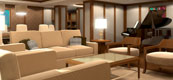
 For those who have entered a spa and never wanted to leave, Celebrity Equinox offers the new AquaClass stateroom. Sharing a deck with the AquaSpa® relaxation room, it incorporates select spa elements into the staterooms, allows for specialized access to spa amenities, and features assigned seating at the healthfully delicious Blu.
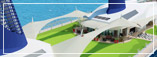 There's absolutely nothing like it. A freshly manicured lawn on the highest deck of Celebrity Equinox. This is The Lawn Club. Enjoy casual outdoor activities in a decidedly Country Club atmosphere, and let the grass between your toes take you places no cruise has gone before.
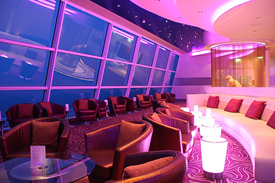
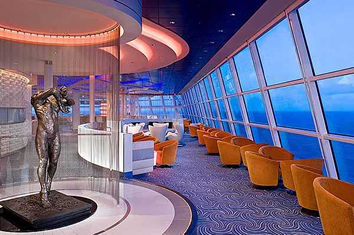
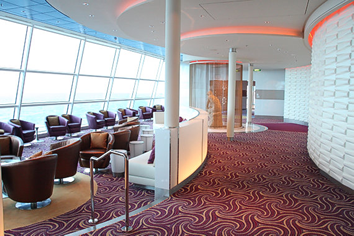
  Don't look back, look forward and be amazed by the breathtaking views in our ultimate observation lounge. The floor to ceiling windows will captivate and the expansive space will please you as you relax in the comfy seating all around. The lounge is versatile and can be transformed to suit any occasion.
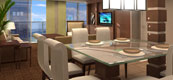
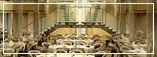 The magnificent and luxurious main dining room of Celebrity Equinox. With a two-story glass wine tower and dazzling chandeliers, this quintessential dining area has a decidedly Hollywood aura. Serving savory World & Continental cuisine, complete with Celebrity's famed European-style service.
 For an evening of lively, spontaneous entertainment, the versatile Celebrity Central is the perfect destination. Catch a late night comedy show, live musical performances, or a great movie in a comfortable, casual atmosphere.